Hey readers,
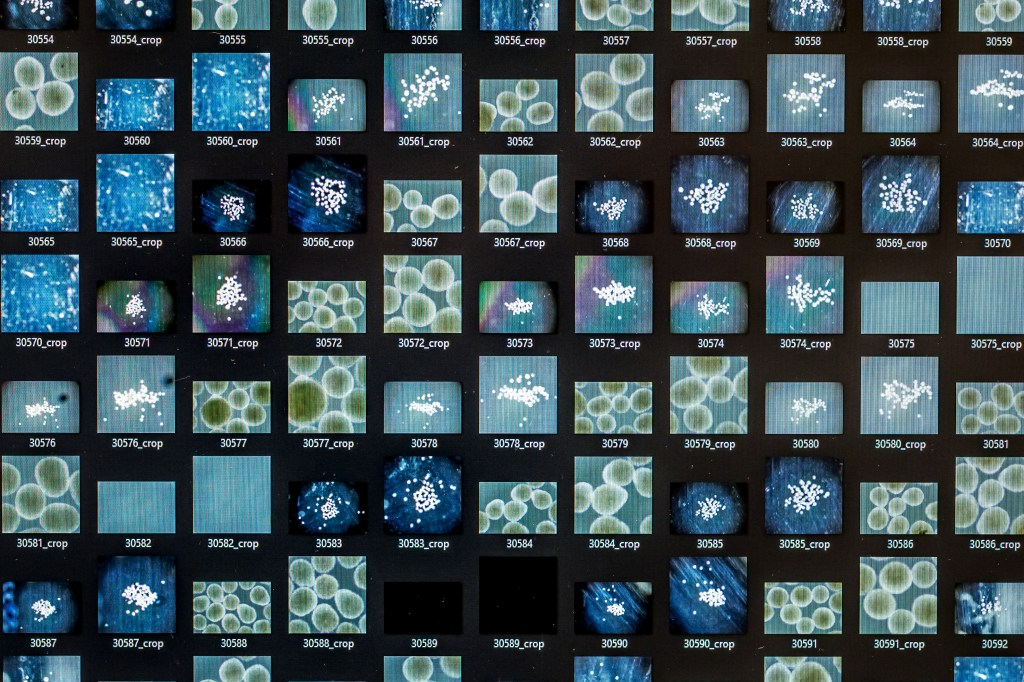
It's Shayna Korol here. They're growing miniature 3D brains from stem cells. These aren't your fictional mad scientists' brains in a vat; they're organoids, and they grow in petri dishes. They're also incredibly cool. We can, should, and will use cerebral organoids to discover new medical treatments, study brain development, reduce the demand for animal testing, and even power computers and more energy-efficient AI. Lab-grown miniature brains may sound like sci-fi, but they're totally real and happening right now. The Braingeneers team at the UC Santa Cruz Genomics Institute recently received a $1.9 million grant to study organoid intelligence — aka their ability to learn, respond to stimuli, and complete tasks. The brain organoids interact with the outside world through electrical and chemical signaling. |
David Paul Morris/Bloomberg via Getty Images |
"These organoid models provide an unprecedented opportunity to probe the emergence of human cognitive capacity — a property that defines what makes us human," Tal Sharf, a biomolecular engineering professor leading the research, said in a press release. Braingeneers' researchers will use reinforcement learning techniques — common in machine learning for tasks that require adaptability like driverless navigation — to discover how organoids can respond to sensory inputs to solve problems. Sharf's team will create benchmarks for organoid intelligence to understand how they learn and monitor them for the possible emergence of consciousness. That won't be easy. There's no universally agreed-upon definition of consciousness, and it would be difficult to measure that state in what are very simplified tissues. We can't exactly ask them how they're feeling. Such work, and even the existence of mini-brains, raises a host of ethical questions, especially as organoids become more sophisticated. The brain itself has no pain receptors, but our meninges — membranes around the brain — have neurons that can send pain signals to our grey matter. It's possible that sufficiently advanced organoids could experience the same. If brain organoids can become conscious and experience pain, is it immoral to experiment on them? These ethical questions are "just as exciting as the scientific and technological ones," said Hank Greely, the director of the Center for Law and the Biosciences at Stanford University, in the press release. "They range from the status of the human brain organoid and, ultimately, an organoid computational device — should they be treated as human tissue samples, as lab animals, as persons, or something else entirely — to the details of the informed consent process for people whose cells are used to make these organoids." But consciousness is "very far down the line," Jenny Tam, the director of synthetic biology at Harvard University's Wyss Institute, told me. Although neurons in brain organoids "talk" with each other and work in synchronicity, that almost certainly doesn't translate to consciousness in the current models. That researchers are seeing cells in these organoids make neural connections is incredibly cool, even if it doesn't add up to consciousness. "It excites the imagination," Tam said, this question of, "What does it mean to be conscious?" Most cerebral organoids represent only a single region of the brain. Johns Hopkins University researchers created a whole-brain organoid earlier this year, but it's much smaller than the real deal, adding up to around 6 million neurons compared to the tens of billions in adult brains. That puts it at a similar level of development to a brain in a 40-day-old human fetus. Their comparative simplicity belies the fact that brain organoids are an incredibly valuable tool for studying neurological disorders. Understanding how schizophrenia, Alzheimer's disease, and bipolar disorder develop at a cellular level enables scientists to find better targets for treatments. Somewhere around 90 percent of all drugs fail during Phase 1 clinical trials. For neuropsychiatric medications, the failure rate is an astonishing 96 percent, according to Johns Hopkins researchers. The failure rate is so high, partially because neuroscience is incredibly hard, but the under-recognized reason lies with our reliance on animal testing. Researchers overwhelmingly use animal models, which don't make for great test subjects for pharmaceuticals intended for humans, for early-stage drug development. All of which complicates the ethical questions around brain organoids. We know for a fact that test animals experience pain. It seems much better to me to risk potential organoid suffering over animals definitely suffering — and for little to no medical benefit in the case of neuropsychiatric research. But here's something spooky: Using brain organoids to power computers blurs the line between humans and machines. So, get ready for renewed debate around AI consciousness, welfare, and maybe even personhood. Happy Halloween! |
|
|
| Shayna Korol Future Perfect fellow |
|
|
| Shayna Korol
Future Perfect fellow |
|
|
| Sara Herschander
They're wealthy, reclusive, and they want to suck your blood. No, I'm not talking about vampires. I'm talking about the nation's motley crew of ultrawealthy, death-averse billionaires. Together, they've spent upwards of $5 billion (according to the Wall Street Journal) on experimental treatments they hope will help them live longer. (Or in some cases forever.) Among the most well-known is Peter Thiel, founder of PayPal and Palantir. He brought his entire PayPal team to a freezing party in the late '90s, where they could opt in to cryogenically preserve their heads or corpses in a liquid nitrogen-filled coffin, err, "cryostat" after they die. He and other tech tycoons like Jeff Bezos have pumped their fortunes into research on 3D-printed organs and drugs that could "vaporize" disease and "de-bug" damaged DNA. Not to mention the controversy that bloomed a few years ago when Thiel expressed interest in using teenage blood plasma to reverse the aging process. "On the record, I am not a vampire," he felt the need to clarify in 2018. Look, I get the ancient impulse to hack death. But there's something…dare I say, eerie…about people who impulse-invest in their own pricey, hyperniche therapies instead of supporting underfunded health interventions that could absolutely save or prolong people's lives right now. The thing is, we know that few of these fancy anti-death therapies will ever be available for the rest of us. If we can't get people their malaria vaccines, HIV treatments, and mosquito nets today, do we really think that we'll all be able to freeze our corpses anytime soon? All I'm saying is, next time you're in Silicon Valley, don't forget the garlic. |
|
|
Pratik Pawar
OK, I gotta give it to Sara for this being all creepy. Billionaires pumping themselves with young blood or preserving their heads on ice is super duper creepy. And somehow that whole billionaire circus has come to be linked with the whole field of longevity. But longevity research is more than that. Consider Rapamycin. It was a compound discovered in the '70s from bacteria in Easter Island, and it somehow slowed aging in lab mice. That quirky finding opened up the study of the pathways that control how our cells age. And those same systems now underpin many of the FDA-approved drugs used for transplants and cancer treatment. Heck, one line of the research has even improved flu-vaccine responses in older adults — a literal case of longevity research making elderly people stronger. That's not to say all longevity research has borne fruit, and I would personally prefer some of that money going to solving longstanding problems like TB or cholera — the real vampiric stuff. But creepy billionaire stuff aside, studying how to live forever might just help us live better right now. |
| |
|
I'm in the mood for more horrors: |
|
|
CAN'T STOP THINKING ABOUT... |
|
|
| Title: Deputy Editor
What I do: I'm in charge of the fellowship program! And this newsletter!
What I'm going as for Halloween: Any Jujutsu Kaisen fans? I'm going as Maki Zen'in post-Shibuya (IYKYK). |
|
|
Only one thing has been on my mind for the last week: Guillermo del Toro's Frankenstein. I was incredibly lucky to watch it in IMAX in New York City's favorite cinema, the AMC at Lincoln Square. Watching Oscar Isaac — the love of my life, probably — as the mad scientist Victor Frankenstein was both enthralling and bone chilling, but it was Jacob Elordi's unexpected performance of the creature that was the most haunting. (Who knew Mr. Kissing Booth had it in him?)
In any case, GDT's adaptation of Mary Shelley's iconic sci-fi novel splits away from other films that suffer from the tired trope that the monster is, well, the monster. There's a humanistic and romantic touch to the dialogue, cinematography, and even the costuming. The viewer is pushed to the edge of the grotesque, but the real horror isn't the chopped-up dead bodies. It's the burden of creation, and asking yourself what, or who, is deserving of empathy.
The limited theatrical release ends Friday, November 7, before it heads to Netflix for streaming. Trust me, you're gonna wanna watch this on the big screen.
|
|
|
⭐ ONE WAY TO DO GOOD THIS WEEK |
One of my first Halloween memories was trick-or-treating in a homemade Teenage Mutant Ninja Turtle costume, lugging a candy bucket and a little orange donation box door to door. I didn't know it at the time, but I was one of the one million kids to trick-or-treat a whopping $200 million for UNICEF since 1950. That's enough to buy 10 million pounds of candy. But I'm much happier to see the money go to UNICEF's work supporting children's health and education around the world. And your kid can join in on the tradition this year, too. Even if you didn't pick up an orange box in time, you can still download a printable QR code to trick-or-treat with or start an online fundraiser for UNICEF today. Happy haunting! —Sara Herschander |
|
|
Want more Future Perfect in your inbox? Sign up for more newsletters here. Need advice? Submit a question to Sigal Samuels's advice column Your Mileage May Vary. |
|
|
Today's edition was edited and produced by Izzie Ramirez. We'll see you Sunday! |
|
|
|









Commentaires
Enregistrer un commentaire
Thank you to leave a comment on my site