"Always carry champagne," Napoleon Bonaparte, man about Europe, is supposed to have said. "In victory you deserve it, in defeat you need it." What did National Review win and lose in our first 70 years?
Now, that, of course, is an interesting and important question. And it's how senior editor Richard Brookhiser begins his essay on "The First 70 Years" of this magazine and this institution.
His subtitle is also significant: "Lessons, losses, and rewards along the way."
Indeed, there have been plenty of all three. There have been highs and lows, victories and defeats. There have been celebrations and there have been wakes.
Here's how Rick describes the fall of the Soviet Union: "The great victory was the defeat of Soviet communism. In August 1991, I was on my way to a vacation in Egypt when Soviet Communist Party hard-liners made their move to oust Mikhail Gorbachev. Only days later I opened my hotel door in Cairo to find a copy of that morning's International Herald Tribune with the headline, 'Communism Collapses.' "
It had been, as the title of senior editor James Burnham's column on world events put it, a protracted conflict. A number of NR's earliest editors and writers had been engaged with communism long before the magazine was born. As a young man, Burnham was Trotsky's leading American disciple. Fellow columnist and book review editor Frank Meyer worked in Europe for Walter Ulbricht, future satrap of East Germany. Publisher Willi Schlamm and contributor Max Eastman each interviewed Lenin. Whittaker Chambers ran a Soviet spy ring in Washington, D.C. These men knew the beast from within. All had served it, all had broken with it. NR became their vessel for fighting it.
The Cold War ended in victory for the West, thank God. But there were, as Rick writes, "many losses along the way": The crushing of the 1956 Hungarian Revolution by the Soviets. Containment instead of rollback. Cuba. The Vietnam War. Détente. It didn't always look like final victory was on the way during that long twilight struggle — not by a long shot.
Domestically it was much the same. There was the triumph of the Reagan Revolution. There was James Buckley's unlikely election to the Senate. There were the sea changes of originalism, of tax and welfare reform, and of Dobbs. But there were also defeats: Goldwater in '64. The Great Society. The return of tariffs and protectionism. Casey. Obamacare. As conservatives we live with this because we know that there are no final victories and no final defeats. We take the world as it is.
"The creed the conservative movement adopted," Rick writes, "was Frank Meyer's fusion of liberty and tradition, which he thought was all-American: freedom in law and in the marketplace, piety on the lips and in the heart."
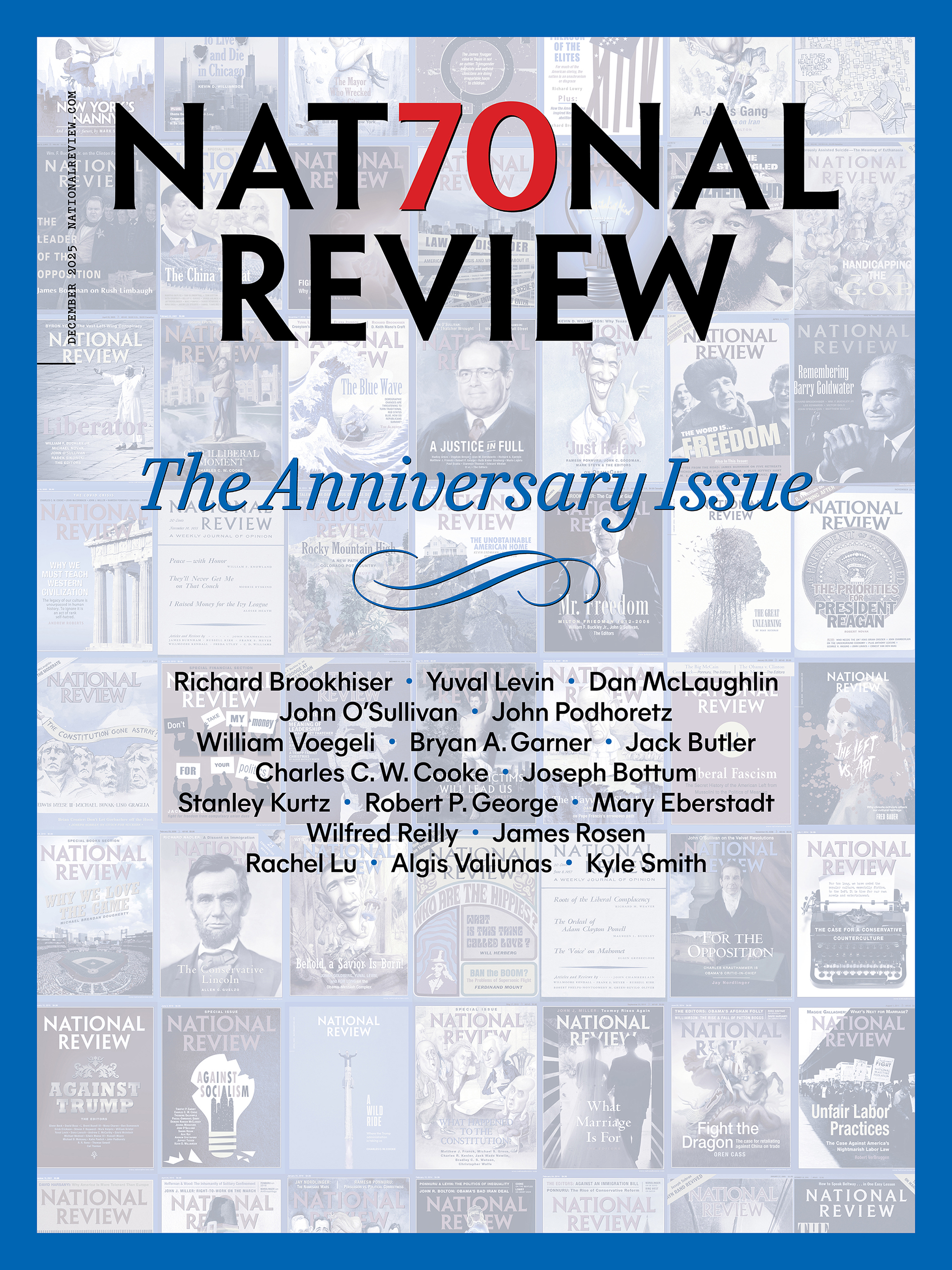
Read the whole thing here in the new, December 2025 issue of National Review magazine. In this special 70th anniversary issue, you'll find a wide and rambunctious range of essays, including:
The anniversary issue's Books, Arts, & Manners section is not to be missed either. This month we feature essays from Joseph Bottum, Stanley Kurtz, Robert P. George, Mary Eberstadt, Wilfred Reilly, James Rosen, and Rachel Lu on the classic works that have shaped our era's conservatism — not to mention Algis Valiunas on Kafka's The Trial at 100.
And don't miss Kyle Smith's Happy Warrior column ("A few things have changed since the first issue of NR exploded off the press to begin this never-ending mission to enlighten, enrage, and publish six-syllable adjectives") or Sarah Schutte's Our Spacious Skies essay, where you'll find her in an open-cockpit biplane over Dayton, Ohio.




Commentaires
Enregistrer un commentaire
Thank you to leave a comment on my site