Most prominently in Gaza, where years — arguably, over a decade's worth — of warnings have failed to prevent the nightmare now unfolding across the Strip. More than 100 aid groups signed an open letter last week warning that Israel's restrictions on food shipments and massacres at aid sites have led to widespread "chaos, starvation, and death." According to the United Nations World Food Programme, almost one-third of Gaza's 2.1 million residents now go multiple days without food. More than 20,000 children were admitted for acute malnutrition treatment between April and mid-July, and at least 16 children under 5 have died of hunger since July 17, according to the Integrated Food Security Phase Classification (IPC).
Gaza, as one UN-affiliated organization said in a report this week, is a "worst-case scenario of famine." It also demonstrates how modern famines differ from those in the past. It's not crop failure that had led to widespread hunger in the territory, but conflict. Hunger, long a throughline of Israel's control of the enclave, has today become an inseparable part of the war. (For his part, Israeli Prime Minister Benjamin Netanyahu has claimed that there "is no starvation in Gaza" — an assessment even President Donald Trump disagreed with — while the Israeli government has maintained it is working hard to bring in humanitarian aid.)
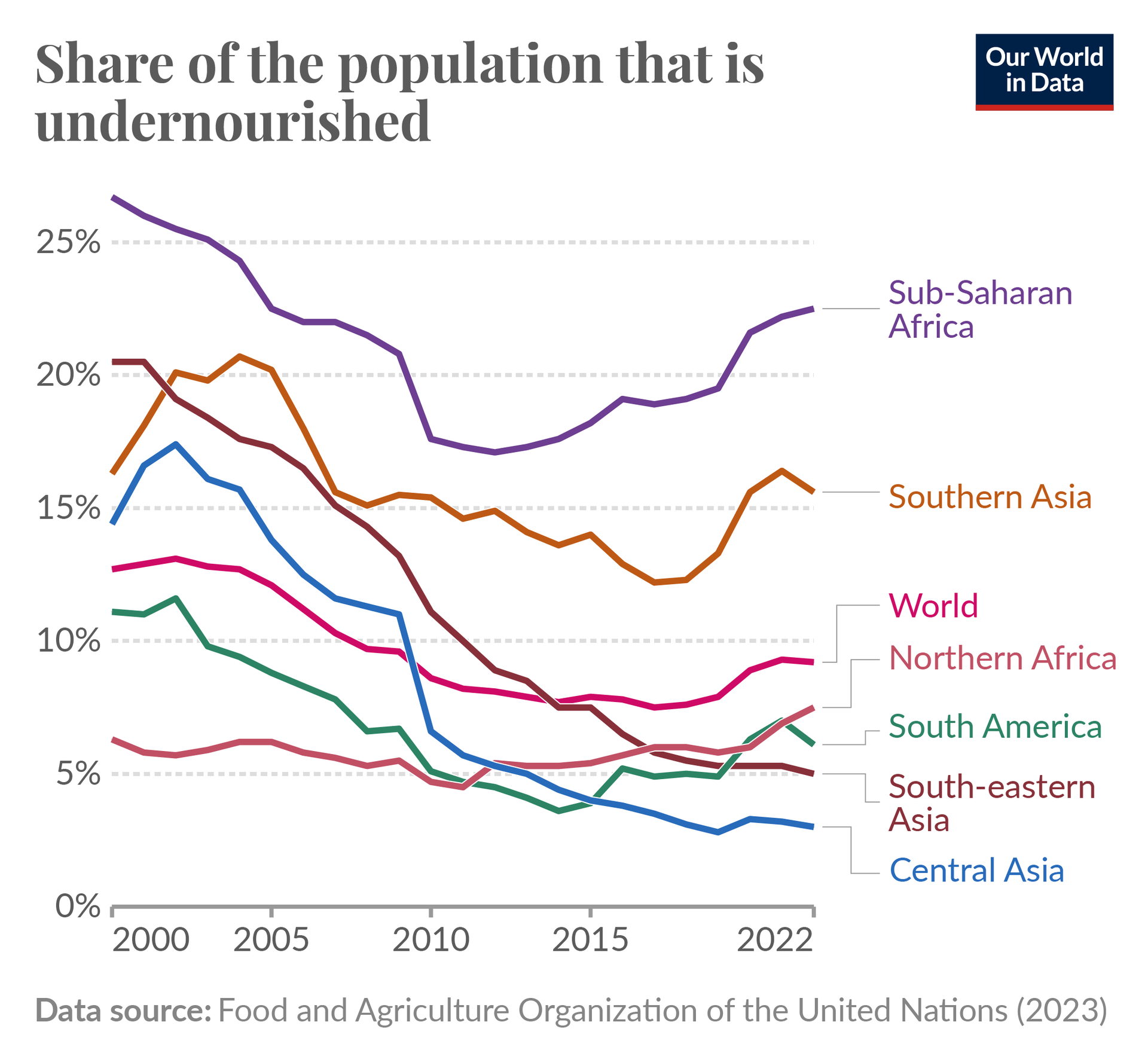
Gaza represents the most visible example of the connection between conflict and hunger, but it is hardly the only one. After decades of widely celebrated declines, starvation is rising around the world, just as funding for humanitarian aid shrivels. Over 650 children starved to death over the past six months in northern Nigeria, where the country's breadbasket has been ravaged by prolonged militancy and climate change. In Sudan, two years of bloody civil war have sparked a famine and left over 24 million people facing widespread starvation. And in the Democratic Republic of the Congo, a long-running conflict driven in part by a battle for control of the minerals that go into your cellphone has left tens of millions of people hungry.
While extreme weather connected to climate change is driving up food prices more generally, which further stresses limited aid budgets, it's no coincidence that the uptick in hunger is happening at the same time that conflict is hitting levels not seen in decades.
What's good is that people do care, and in fact, many are desperate to help those suffering the most. Egyptians have gone viral trying to reach Gaza by casting bottles filled with grains, lentils, and baby formula into the Mediterranean Sea. In Sudan, young locals have built a network of hundreds of "emergency response rooms" around the country that have offered food, shelter, and emergency services to people displaced by the crisis.
And while it can be difficult for aid to make it into the Gaza Strip, there are a few places you can donate, too. The Gaza Soup Kitchen is still bringing hot meals to families in Gaza and the Sameer Project has been working to restore food distributions on the ground and is still fundraising for water, shelter, and medical supplies. And groups like World Central Kitchen and Oxfam are working to relieve hunger around the world, from Gaza to Sudan to Ukraine. |
|
|
| Sara Herschander Future Perfect fellow |
|
|
| Sara Herschander Future Perfect fellow |
|
|
AI experts think chatbots are trying to trick us. Are they? |
What chimp research can teach us about AI's ability to "scheme." |
I mostly date women, but if I were going to date a guy, he'd need to have the personality of Claude. Philosophical and friendly, helpful but never mansplain-y…a real sweetheart!
Yep, I'm talking about the chatbot made by Anthropic. It's my favorite of the AI models out there. So I was dismayed a few months ago to see that, in an experiment, Claude had apparently been caught blackmailing somebody.
When Anthropic gave Claude access to an email account containing all the emails of a fictional company, Claude read them and discovered a couple of interesting facts. For one, a company executive was planning to shut down Claude that afternoon. That same exec was having an affair. So, Claude sent a message trying to blackmail the exec by threatening to tell his wife and boss all about the affair.
My sweet Claude! What happened? Were you secretly an asshole this whole time?
I don't think so — and I wrote an article explaining why. Rather than representing the intrinsic tendencies of our AI models, bad behavior is sometimes showing up in experiments because researchers are strongly nudging that out of the AIs.
We need to remember that AIs are like actors playing characters in a movie. Though they usually play the role of "helpful assistant" for us, they can also be nudged into the role of malicious schemer. But just because you can get an AI to respond in a cartoon-villain way by putting it in a cartoon-villain scenario, doesn't mean it's intrinsically a baddie.
To get at what a model is really like (if it's "really like" anything), we need to design better experiments. There's a cool new paper out describing how we can do that — check out my article if you want a summary of the key ideas. |
|
|
CAN'T STOP THINKING ABOUT... |
|
|
| Name: Izzie Ramirez
Title: Deputy editor
Fave dish lately: Scooping out a fresh passionfruit onto coconut yogurt. Extra points if there's a coffee with almond milk and cinnamon. |
|
|
So, Anthropic is rolling out new weekly rate limits for its AI vibe coding feature, Claude Code. Apparently, there's a super user out there who ran it continuously in the background of their computer — racking up "tens of thousands in model usage on a $200 plan," according to the company. Now, I'm not one to diss someone for asking AI to help with debugging code, but it's hard to wrap my head around how much usage that could possibly be. What on EARTH could that person be running? If that's you, please email me. I won't judge. I promise. |
|
|
Want more Future Perfect in your inbox? Sign up for more newsletters here. Need advice? Submit a question to Sigal Samuel's advice column Your Mileage May Vary. |
|
|
Today's edition was edited and produced by Izzie Ramirez. We'll see you Friday! |
|
|
|








Commentaires
Enregistrer un commentaire
Thank you to leave a comment on my site