Pop psychology further assures us that although boundaries might feel selfish, they're really the opposite: The more you protect your own well-being today, the more you'll be able to help others tomorrow! But this is weirdly instrumentalizing; it treats you as a means to an end, not an end in yourself. It makes it sound like your actions are only justifiable if their ultimate aim is to serve others' needs — exactly the sort of "self-sacrifice is all that matters" mentality that boundaries are meant to get you away from.
To make matters worse, some people bastardize the concept of boundaries by brandishing boundary language as a cover for avoidance. We've all got that friend (or Instagram influencer) who says, "Nope, I'm drawing a boundary!" any time they're being asked to do something that would be even a little hard or uncomfortable.
You write that any act of self-preservation feels like a slight at your own ideals. The answer is not to just give up on self-preservation — that approach can literally kill you. Instead, you need an ideal that both honors the importance of self-preservation and offers you a moral vision you can actually believe in.
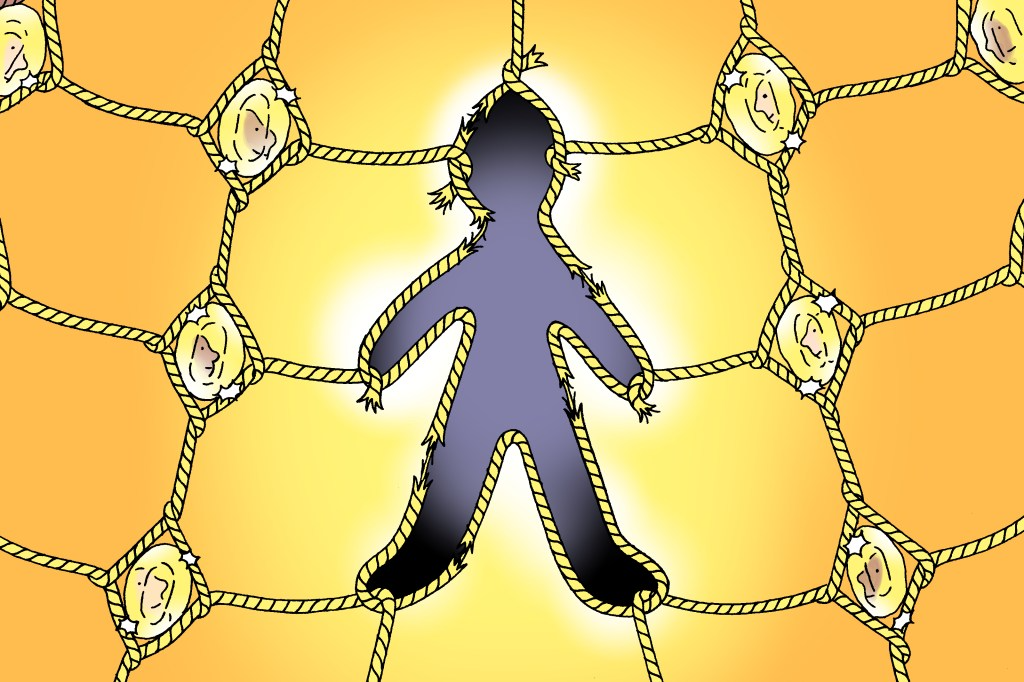
So, allow me to present Indra's net, a classic Buddhist metaphor that originated in ancient India.
Picture an infinite net stretching out across the universe (a bit like a spiderweb). At each node where the threads intersect, there's a jewel (a bit like a dewdrop that sits on the spiderweb). And each jewel is so shiny and reflective that it contains the image of every other jewel in the entire net, which means each jewel also contains the reflections of the reflections, and the reflections of those reflections, on and on forever.
This is reality, the Buddhists say. No jewel exists as a separate, boundaried entity. Change one jewel, and every jewel in the net transforms, too, because they're all reflecting each other. Change one person, and every person changes, too.
The idea that everything is constantly remaking everything else is what Buddhist philosophers call "dependent co-arising," or "interdependent origination," or sometimes "interbeing," but honestly, you don't need any fancy terminology to understand it. If you've ever walked outside early in the morning and seen a spiderweb covered with dew drops, with each dew drop reflecting everything else around it, you get the basic idea.
I think picturing yourself as part of this web might really help you. If you see yourself as one of the jewels in the net, you immediately realize a couple things. First, there is no sharp distinction marking off "where I end and where you begin." And you don't take care of yourself today so that you can better take care of me tomorrow. You take care of yourself because you are one of the jewels in the net. You are inherently precious! And if you mess up your own well-being, you are smudging up one of the jewels — or worse, creating a rip in the net!
Yes, smudging up your jewel will change the reflections in all the other jewels, so it's a problem on the level of how you affect others. But it's also just a problem on the local level. You have failed to treat one of the jewels as precious. You've caused a rip. That is not morally praiseworthy.
I've written before about contemporary philosopher Susan Wolf's concept of the "moral saint": someone who tries to make all their actions as morally good as possible. Wolf argues that this is actually a bad ideal, because if you're doing constant self-sacrifice, you end up living a life bereft of the personal projects, relationships, and experiences that make up a life well lived.
"If the moral saint is devoting all his time to feeding the hungry or healing the sick or raising money for Oxfam, then necessarily he is not reading Victorian novels, playing the oboe, or improving his backhand," she wrote. "A life in which none of these possible aspects of character are developed may seem to be a life strangely barren."
It's clear that Wolf finds this sort of life distasteful. But your question prompted me to ask myself: What is it, exactly, that makes it so distasteful? Why does it actually give Wolf — and me — the ick?
I would argue it's because someone who is hyper-focused on giving to others is refusing some of the great gifts of life. Life is constantly offering us gifts: The taste of an unusually good meal. The pleasure of feeling your body move on the dance floor. The intimacy you feel in a late-night conversation with a friend. The specific, delicious, bright shade of green you see on the underside of leaves when the sun shines through them at four o'clock.
When someone offers you a gift — as life is offering you just by giving you a healthy body and mind and a beautiful planet — the gracious thing to do is accept it and enjoy it.
And when I picture the jewels in Indra's net, I imagine that it's basking in the light of all these gifts, that makes the jewels really gleam. If you don't let yourself experience and savor all these things and feel well, and happy, and fulfilled, I suspect you are dulling yourself. That does not improve the net; it detracts from it.
Of course, caring for the well-being of others can itself be extremely gratifying. But the problem creeps in when you let that crowd outweigh everything else, ultimately tarnishing your own well-being. The language you use to describe your current state — "my fear is that I know that I will give, give, give until I'm nothing," and "resentment bubbles away anyhow because I'm so overextended." — tells me you're putting too much of your energy into caring for others and not enough into caring for yourself.
Feeling fear and resentment while offering "charity," or "service," or "help" to others is not actually being in right relation with others. It's an all-too-common form of martyrdom that sets up a hierarchical dynamic between a long-suffering "giver" and a passive "receiver." The alternative is to stay horizontal, to think, "I'm a jewel in the net, you're a jewel in the net, and I'll offer whatever I can offer without damaging my well-being — without ripping my part of the net."
So, dear reader, play with finding that balance. You'll know you've found it when you don't feel resentful — you just feel tightly connected to others and gleam.






Commentaires
Enregistrer un commentaire
Thank you to leave a comment on my site