Before we get launched into the stunning success of New York City's risky traffic experiment and the use of AI to possibly help improve the foster system, here's a quick update on what's happening in the world of Future Perfect: |
📲 Send us your questions! If there is a topic you want us to explain or a story you're curious to learn more about, fill out this form or email us at futureperfect@vox.com. —Izzie Ramirez, deputy editor |
|
|
Hey readers,
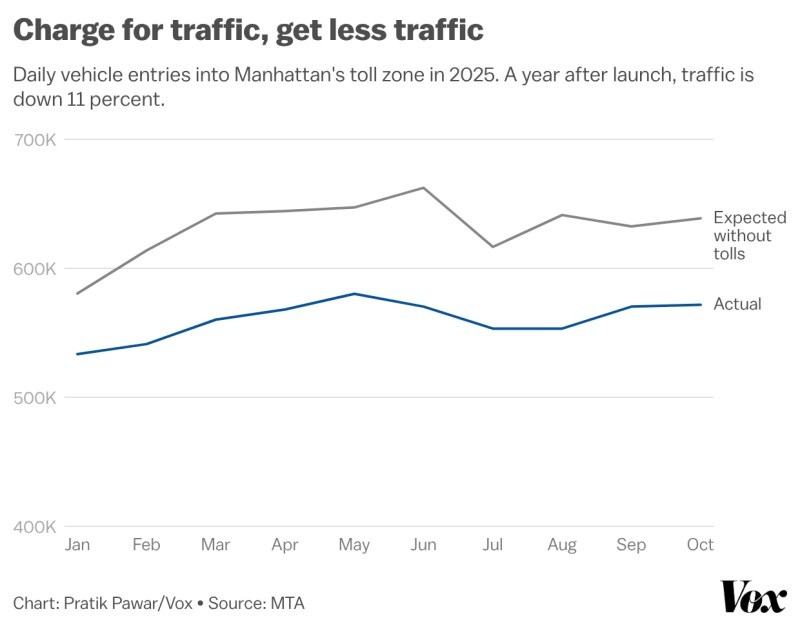
It's Pratik here. Could a $9 toll change notorious traffic? New York became the first American city to find out. A year ago, it began charging drivers for entering Manhattan's busiest central neighborhoods during peak hours. Critics called it a cash grab, and President Donald Trump even vowed to kill it. But a year in, congestion pricing has largely proved to be a success, according to new data released by the Metropolitan Transportation Authority — the agency that runs New York's massive network of subways, buses, and commuter rails. Since tolling began, 21 million fewer vehicles have entered the toll zone, an 11 percent drop from what was projected without it. And average vehicle speeds improved by 23 percent. That's the difference between a one-hour crawl and a 45-minute commute. |
But the real gains came at the entry points. At the Holland Tunnel, for example, morning rush hour speeds jumped from 10.8 to 16.2 miles per hour — a 51 percent improvement. A separate analysis that used anonymized Google Maps data found these improvements spilled over to regional roads, meaning even drivers outside the zone got faster commutes. Public transit riders benefited, too. After years of steady decline, average bus speeds in the zone ticked up 2.3 percent, reversing the trend seen in 2023 and 2024. Subway and bus ridership is up too, carrying more than 400,000 riders every day compared to 2024. It's easy to dismiss traffic as just a nuisance, but sitting in it is linked to higher stress, lost productivity, and worse air quality for everyone. Getting people out of cars and onto transit helps on all three fronts. Streets got safer. Crashes involving trucks in the zone dropped by 21 percent compared to the previous year. The MTA made money. Net revenue exceeded the MTA's initial projections. That cash is earmarked for transit upgrades, including modern subway signals, 56 new elevators for accessibility, and the Second Avenue Subway extension. The one place the jury is still out is on air quality. It's worth watching because air pollution is a quiet killer. In New York City alone, fine particulate matter contributes to roughly 2,000 deaths and over 5,000 hospitalizations each year — and traffic is a major source of those pollutants. A recent study from Cornell found a 22 percent decline in one kind of particulate matter after congestion pricing went into effect, while another analysis found little effect. The MTA's own analysis showed no significant change in pollution levels. If London and Stockholm are any guide, it'll take a few years of data before congestion pricing's effects on air quality becomes clear. There's also the question of drivers who, looking to dodge the toll, might reroute through Queens or other neighborhoods outside the zone. The MTA has anticipated that and earmarked $100 million to offset potential air quality impacts in those neighborhoods: funding school air filters near highways and swapping out diesel equipment for electric. The vocal opposition that greeted the program's launch has largely died down, similar to what happened elsewhere. When Stockholm launched its congestion pricing in 2006, two-thirds of residents opposed it. After a six-month pilot, they held a referendum. More than half voted to keep it. New York seems to be on the same arc. Gov. Kathy Hochul, who delayed the program in 2024, now touts it as an "unprecedented success." And other cities are paying attention. Officials in Los Angeles have already reached out to New York for advice on their own potential pilot project, according to Gothamist. Turns out, if you charge people to drive, fewer people drive. Who knew. |
|
|
| Pratik Pawar Future Perfect fellow |
|
|
| | Pratik Pawar Future Perfect fellow |
|
|
Who's afraid of big, bad Yellowstone? |
Yellowstone can be a deadly place... but not for the reasons you might think. |
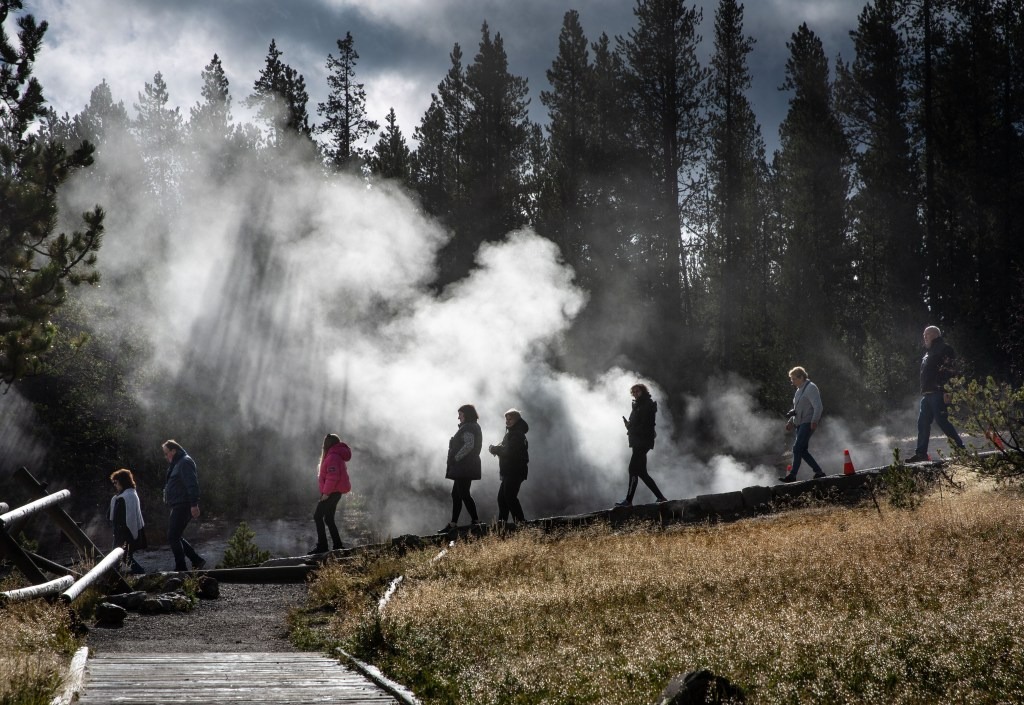
As a fully licensed purveyor in doomsday stories, I've always been fascinated by Yellowstone, which supposedly sits on top of a "supervolcano" that could wipe out humanity any day now. But in the latest Unexplainable, Byrd Pinkerton calls up US Geological Survey volcanologist Mike Poland to pop that balloon. Yellowstone has had enormous eruptions, yes — but it's not "overdue," and a true supereruption is wildly unlikely on any human timescale. If the system were ramping up, Poland says, we'd expect clear, sustained warning signs. Yellowstone is closely monitored by scientists around the clock, but you still can't put sensors on every pool there. What might actually hurt you sooner is less Hollywood: strong earthquakes and hydrothermal explosions, like the 2024 steam blast at Biscuit Basin near Old Faithful that sent tourists sprinting. Byrd's episode is really about risk perception: how we fixate on cinematic catastrophes while missing the smaller, more probable hazards right under our feet. —Bryan Walsh, senior editorial director |
|
|
The Vox Membership program is getting even better with access to Vox's Patreon, where members can unlock exclusive videos, livestreams, and chats with our newsroom. Become a Vox Member to get access to it all. |
|
|
CAN'T STOP THINKING ABOUT... |
|
|
| Title: Future Perfect fellow
What I cover: Global health, inequality, and philanthropy
My fitness inspo for 2026: Every contestant on Netflix's Physical 100 and Physical: Asia! |
|
|
Hey, ooooooh, this feels illegal. Late Friday night, a mystery trader on Polymarket — the crypto-based predictions betting site — placed a suspiciously well-timed wager on the imminent ouster of Venezuelan leader Nicolás Maduro. By the time the rest of us awoke to the news on Saturday morning, as a warship hauling a blindfolded Maduro weaved its way up the Atlantic, the investor netted over $400,000 on his successful bet. If that sounds an awful lot like insider trading, that's because it probably is. In the hours leading up to Maduro's capture, a cluster of new anonymous accounts on Polymarket placed similarly prescient bets exclusively on topics related to Venezuela and Maduro, earning at least $620,000 over the weekend. Chances are, a little birdie with advanced knowledge of the top-secret attack told them exactly when to wager. While some of Polymarket's bidders have been left seething over the platform's refusal to let them cash out their prediction for a full-scale "invasion" of Venezuela — apparently, Maduro's capture doesn't count — most of these newer accounts knew just what to say to get their payout. And prediction markets like Polymarket can be very easy to manipulate in this way, because unlike the stock market or other forms of gambling, they remain almost entirely unregulated. Last month, another mystery Polymarket trader made a flurry of uncanny bets around Google's 2025 Year in Search rankings, netting almost $1 million and likewise sparking accusations of insider trading.
Some lawmakers have reacted to the $400,000 haul by proposing legislation to curb insider trading on prediction platforms. But — womp, womp — given the Trump family's ongoing love affair with all things crypto, including Donald Trump Jr.'s position on the Polymarket advisory board, real regulation seems unlikely to pass anytime soon. Or at least, I wouldn't bet on it.
|
|
|
Future Perfect fellows Shayna Korol and Sara Herschander argue whether the latest development in AI — this time, AI use in foster care — is dystopian or not. |
|
|
| Shayna Korol
On November 13, 2025, Trump signed an executive order telling states to use AI in foster care. It aims to drive up states' use of AI technologies to increase foster parent recruitment, improve matches between foster parents and children, and make federal funding for child welfare more efficient — in other words, modernizing a deeply flawed system. Please forgive me if I don't trust AI to actually do that. The cynical take here is that this is part of Trump's broader push for deregulation. Children in foster care are a uniquely vulnerable population, and it's irresponsible to treat them as test cases for automation. Look, I'm sympathetic to the argument that the current foster care system needs to change. It simply is not working for the children it serves and the adults who age out of the system. And maybe AI can be a part of that solution — if you strictly control for algorithmic bias that privileges certain groups over others. But I really don't think we can do that with mountains of data or without very strict human oversight. We risk entrenching existing biases and worsening existing problems. And how would this work in practice? Targeted ads to social media users with "parental" vibes or people in certain zip codes? The idea may be well-intentioned, but it's no less invasive. |
|
|
Sara Herschander
I am definitely not the type to say let's just pump AI into every entrenched problem, especially one as sensitive and consequential as the child welfare system. Absolutely not. But there are genuine ways that automation can make a challenging, often bureaucratic and resource-starved system work better. One is foster parent recruitment. Back in 2019, the state of Oregon faced a major class-action lawsuit for failing to protect the children in its care. With far too few homes available, the state often shuffled foster youths between hotel rooms and institutions like converted juvenile jails. Something needed to change. As part of a settlement, a nonprofit called the Contingent took over statewide foster-parent recruitment. The group quickly spent $150,000 — about a quarter of its new state contract — on buying up the same kind of data that advertisers use and building a new AI tool that it could use to identify potential parents. Instead of paying for billboards or setting up stands at local farmers markets, the tool has made it possible for the Contingent to target potential parents for recruitment who live in the right zip code, visit the right websites, or have the right Pinterest boards. And you know what? As icky as it might feel to see a nonprofit use the same sleazy tactics that Amazon and Coca-Cola use to sell you stuff, the Contingent's strategy is working. The group has since expanded to multiple states, including Arkansas, where their approach attracted five times as many foster parents as traditional methods did. So who am I to criticize this kind of AI use when it means that more kids will have a home? After all, if megacorporations and TikTok Shop get to deploy advanced algorithms in the fight for our attention, it's only fair that organizations get to do the same to nudge us into doing something good. |
| |
|
Want more Future Perfect in your inbox? Sign up for more newsletters here. Need advice? Submit a question to Sigal Samuel's advice column Your Mileage May Vary. |
|
|
Today's edition was edited and produced by Izzie Ramirez. We'll see you Friday! |
|
|
|










Commentaires
Enregistrer un commentaire
Thank you to leave a comment on my site