Your guide to what happened on the Hill this week and why it matters.
| |  | March 13, 2026 | | | | | | | | | |
| | | The majority math gets easier, and the prime minister goes back to Europe again
Prime Minister Mark Carney added another MP to his ranks this week, this time from a party on the other side of the political spectrum from where his last three floor-crossers came from.
What's driving his ability to court floor-crossers? Plus, what were the hot-button issues in the House this week? And why isn't Conservative Leader Pierre Poilievre stopping in D.C. during his time stateside?
|  | | The week that was | | |
Obviously, the most dramatic political news this week was New Democrat and Nunavut MP Lori Idlout leaving the shrunken NDP caucus to join the ever-growing Liberal ranks.
The drama started playing out late Tuesday night, when NDP interim leader Don Davies essentially scooped the prime minister with a social media post revealing the defection and expressing his disappointment.
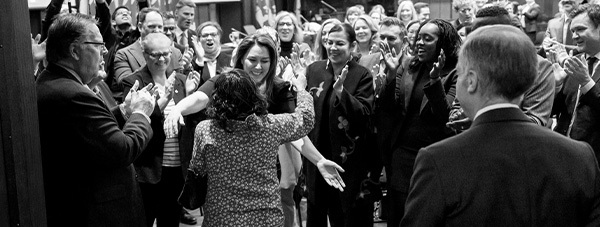
The Liberal Party quickly confirmed, and then Wednesday morning — caucus day on the Hill — there was Carney, coming down the stairs alongside Idlout.
As colleague Mike Le Couteur reported that day, Carney praised his new recruit as one of "Canada's greatest constituency MPs."
Noting that she represents a riding the size of Mexico, Carney called Idlout "down to earth" and said he's had conversations with her about what they can do, "both large and small, in Nunavut."
Speaking to reporters before being welcomed by chants of "Lo-ri! Lo-ri! Lo-ri!" in caucus, Idlout said there were a number of factors that led to her decision to cross the floor.
One factor that was surely front of mind for the prime minister — and those in his inner circle who may have had a hand in courting her — this floor-crossing brings the Liberals to 170 seats, two shy of a majority. That is, with three byelections on the books for April 13, two in Liberal strongholds and a third in a riding that was decided by one vote.
"Well, the math is the math," Liberal caucus chair James Maloney told reporters. "I mean, if we're going to get to 173 if we win all three… obviously there's more stability."
So, what is behind Carney's ability to court floor-crossers across party lines? That's what I dug into this week.
For more on where Carney now places in the history books when it comes to number of floor crossers in recent political past, and why experts say it seems to be a mix of three main factors: the moment, the polls, and the politics. I've got your Saturday morning coffee read.
| |  | | | With those byelections now drawing ever closer, and April 13 being the date reporters are penciling in for more full-on coverage than is common for a one-off race in a riding given the potential majority government-making results, the roster of candidates is becoming clearer.
And, after an all-party take-note debate in the House of Commons on Monday that Carney didn't attend, the conflict and associated Canadian implications was a main focus during question period for the rest of the week.
One of the more intense exchanges was between Poilievre and the prime minister, over what the opposition called Carney's "flip flopping" position on Iran.
"Sometimes the prime minister makes it too easy. Today we have zero oil stockpiles. We have a strategic maple syrup stockpile, which he could use to put maple syrup on the pancakes that he flip-flops on, but we do not have any oil to supply to the world in the time of this crisis. Will he reverse the antidevelopment policies that he has supported?" Poilievre asked in part.
"This is the way the G7 oil reserve works: If a nation is an importer, it has to have an oil reserve. If a nation is an exporter, which Canada is under this government, if it has record exports, which Canada does under this government, that is how it supplies the world. I salute the work of the Minister of Natural Resources and the Minister of Finance, who, working with G7 counterparts confirmed … today the release of 400 million barrels from that strategic reserve," Carney shot back.
This week also marked the one-year anniversary of U.S. President Donald Trump imposing Section 232 tariffs on Canadian steel and aluminum.
Reporters tried to ask ministers for a status update on American tariffs. Industry Minister Melanie Joly said that, when it comes to any progress on lifting the tariffs, that was Canada-U.S. Trade Minister Dominic LeBlanc's job and "that's why you ask him questions." As has become a pattern, when efforts were made to ask LeBlanc, he breezed right on by the cameras without stopping. | | | | |
| | Not to be missed | | 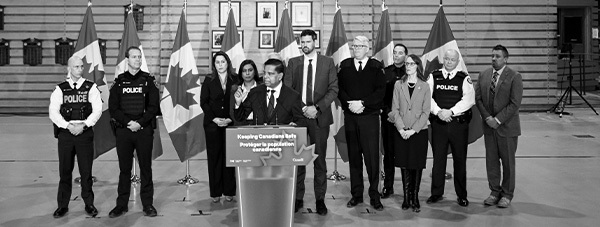 | | Tumbler Ridge MP backs lawsuit against OpenAI The MP for Tumbler Ridge, B.C. Bob Zimmer said he supports the lawsuit against artificial intelligence giant OpenAI, launched by the mother of a girl critically wounded in last month's mass shooting. The lawsuit alleges the company's ChatGPT bot provided shooter Jesse van Rootselaar with "information, guidance and assistance" to carry out such an attack. Zimmer told reporters he thinks the company "needs to answer" for its software. As The Canadian Press reports, B.C. Premier David Eby said last week that OpenAI CEO Sam Altman had agreed to a public apology for his company's role in the shooting, but Zimmer doesn't think that is enough. OpenAI has not responded to the lawsuit. Ottawa drops TikTok ban, retries lawful access bill In two separate pieces of online platform news, this week the Liberals said will allow TikTok to continue operating in Canada now that the government has received security guarantees when it comes to protecting Canadians' data. And then, just a few days later The Liberal government tabled revised "lawful access" legislation, seeking to give police new powers to access digital evidence and act on it more quickly, in what federal officials say is an effort to keep up with advances in technology and increasingly sophisticated criminal behaviour. The version tabled Thursday by Public Safety Minister Gary Anandasangaree is a second attempt at advancing legislation of this kind in this Parliament, after the first version faced major pushback from civil liberty groups. It also proposes to allow police to seek information from foreign electronic service providers, such as major social media companies and OpenAI. CSIS says Iran threat level remains 'medium' And, the Canadian Security Intelligence Service (CSIS) says the threat level in Canada from Iran or its proxies has not changed since the war in Iran began nearly two weeks ago, while adding that threat-related activities are "likely to continue." "The level remains at 'medium,' meaning that a violent extremist attack remains a realistic possibility," a CSIS spokesperson said in a statement to CTV News on Tuesday night. "The most likely scenario for serious violence involves a lone actor whose intent to mobilize is unknown to authorities. Such a person could be inspired by the conflict in the Middle East." CSIS provided the comment after colleague Stephanie Ha asked whether the organization was concerned about potential Iranian sleeper agents or cells in Canada amid the ongoing conflict. | | | | | |
 | | | Quote of the week "Mr. Speaker, there are heroes among us today, and if it were not for them, a life would have been lost. Two days ago, a member of my office suffered a sudden medical emergency, and in those critical moments, parliamentary assistant Ellena Yazdani, Constable Maxime Patry-Lavigne, Constable Matthew Sargeson and many other members of the Parliamentary Protective Service acted immediately. Because of their courage, quick thinking and medical training, a life was saved. I am happy to report he is doing very well. In the hospital, the doctor told me that if there had not been a defibrillator on site, a tragedy would have occurred. I would like to also thank my colleague from Lanark—Frontenac for his endless work in advocating for access to defibrillators. We need more defibrillators in public spaces. Simply put, they save lives." - Conservative MP Ned Kuruc, rising in the House on Wednesday to thank those who responded to an emergency in his office on Monday. | | | | | | |
| | The week ahead | |  | | | Next week is — say it with me — another break week for MPs.
So, mainly what I'm watching over the next seven days are the trips both Carney and Poilievre are taking.
The prime minister is back in Europe, where his office says he will remain "for personal commitments" until March 23. To be clear, that's after stops in Norway and the U.K. that reporters are getting access to cover. But his "personal" time in his former stomping grounds begins ahead of him having an audience with the King.
Defending the decision to take time away from Canada, the prime minister said he will be "as visible as needed and as connected as always."
Meanwhile, Poilievre has headed stateside. After first stopping in Detroit, a.k.a. auto city, he'll be off to Houston, to talk energy, and then on to New York, where he'll be giving a speech on the Canada-U.S. relationship. As the Official Opposition leader noted in a video previewing the trip, he's not going to Washington, as he will be leaving any trade negotiations up to the government.
| |  | |  | | | | | | |
|
You are subscribed to CTV News as aymentanaze.news@blogger.com
You have received this message from CTV News, a Bell Media property.
Bell Media Inc.
9 Channel Nine Ct,
Scarborough, ON M1S 4B5
You can contact us at 1-866-690-6179
NOTICE: Email service providers' one-click unsubscribe links may not always function. To manage your CTV News message preferences, please visit our preference center or use the communications preferences link at the bottom of our emails.
Privacy Policy | Manage Subscriptions | Unsubscribe
© 2022 Bell Media All rights reserved. |
 |







Commentaires
Enregistrer un commentaire
Thank you to leave a comment on my site