Dear Weekend Jolter,
It's never a good sign when the word "allies" is put in scare quotes.
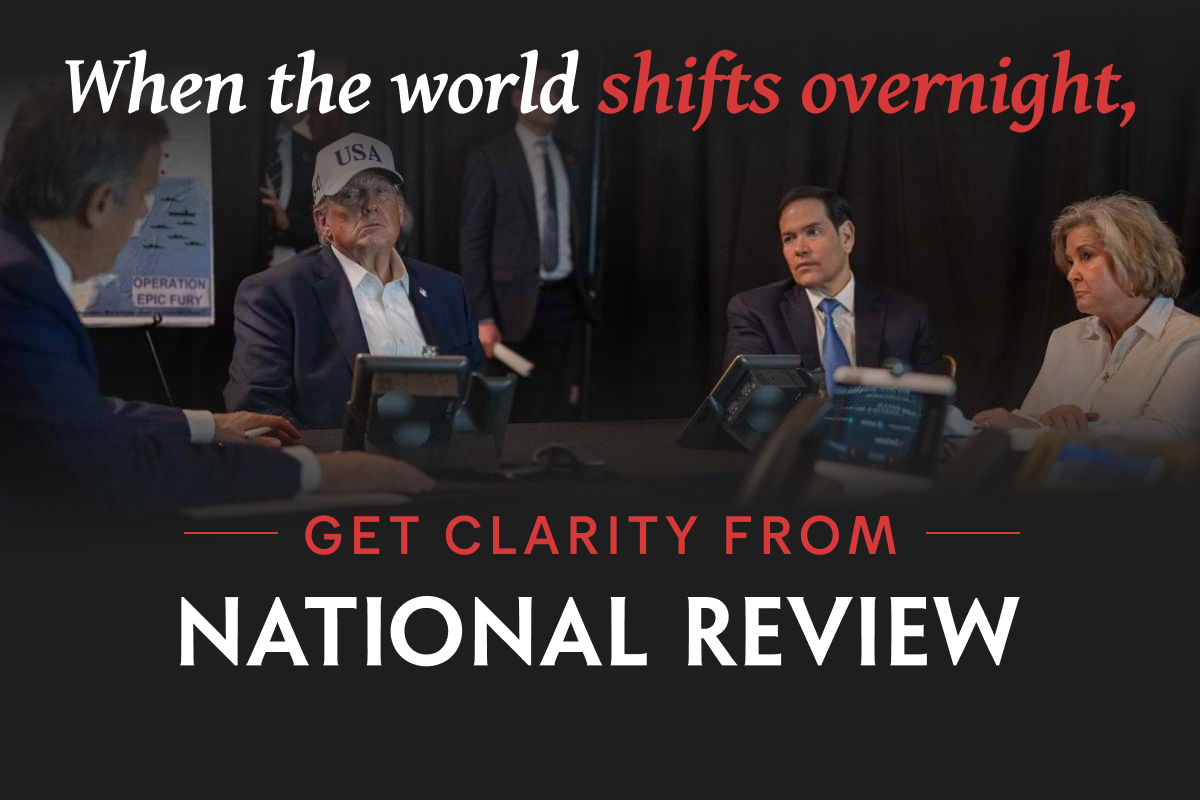
With the Strait of Hormuz effectively closed to most oil tankers, leaders of European and other normally aligned nations have been conspicuously loath to intervene despite President Trump's calls for assistance. He's responded by questioning their usefulness.
It does not help that the U.S. president shunned coalition-building before the war or that he spent the early part of 2026 needlessly needling NATO nations over Greenland. "Donald Trump seems to be learning that gratuitously antagonizing your allies can invite undesirable consequences," Noah Rothman writes.
Still, as Noah notes, the present straits over the strait endanger every nation engaged in the global economy. He urges a reconciliation, and soon:
Whether the international community likes it or not, there will be no going back to a post-war world. Iran is no longer a potential threat to the exploration, exploitation, and shipping of commodities through the Strait. It is an active one that the globe — not just America and Israel — will have to contain for however long the Islamic Republic has left. That will be a commercial enterprise as well as a military venture, and the sooner the rest of the world acknowledges its role, the better. . . .
Whatever hard feelings exist between the Trump White House and America's allies, events should compel everyone to paper over those disagreements. There's a war to win, and the whole world has a stake in it — whether they like it or not.
For now, the tensions over Iran only further strain creaking Western alliances. On Friday, Trump called NATO a "PAPER TIGER," saying of nations' reluctance to contribute militarily on Hormuz, "COWARDS, and we will REMEMBER!" Trump had declared earlier in the week that "WE DO NOT NEED THE HELP OF ANYONE" and described NATO as a "one-way street" where protection is concerned, after facing frosty responses to appeals for help:
• British Prime Minister Keir Starmer said the U.K. is working with other nations to "restore freedom of navigation" while refusing to be "drawn into the wider war." (British advisers reportedly have been sent to U.S. Central Command in Florida to discuss options for the strait.)
• France has offered to help escort tankers — but only "once the core of the bombings has stopped," not "in the current context.” President Emmanuel Macron may turn to the United Nations.
• Italian Prime Minister Giorgia Meloni, normally seen as Trump-friendly, has balked at getting involved.
• "Nothing to do with NATO," a spokesman for Germany's chancellor decreed of the conflict. Defense Minister Boris Pistorius rejected the possibility of German military involvement and scoffed at the idea that "one or two handfuls of European frigates" could accomplish anything that "the powerful American Navy cannot." He urged diplomatic efforts to ensure security through the strait.
While the statements out of Berlin dripped with sloshing steins of derision, they actually point to a key hurdle in the effort to assemble an after-the-fact coalition. Rich Lowry notes that while Trump would like to put together an international force to break Iran's grip on the waterway, "allied countries aren't going to think it's possible to reopen the Strait if we haven't managed to do it on our own." That is, America is the nation with a world-class navy, not, say, Germany.
Per NR's editorial, "There has to be urgency about reopening the strait, and the administration clearly feels it," hence the attacks on and threats against Kharg Island and potential plans to escort tankers.
Actively involved allies would be useful. In their partial defense, MBD explains why the Europeans have a right to be miffed. Dan McLaughlin also observes that the tensions raise a fundamental question about the NATO alliance itself: “Do the member nations of NATO see the organization as a true community of interests, or simply a set of bilateral deals that require continual renegotiation?”
At least Estonia is "ready to talk."
NAME. RANK. LINK.
EDITORIALS
The New York governor is desperate: Kathy Hochul's Seller's Remorse
On Joe Kent's departure: Israel Didn't Make Us Do It
On the Strait of Hormuz: Iran Finds Its Leverage
NR is now on TikTok. Here's why: Why We're Joining TikTok
A perennial declaration, yet still a necessary one: The Jones Act Is a Failure
ARTICLES
Steve Wills: How the U.S. Navy Can Clear the Strait of Hormuz
Yael Bar tur: It's the End of the World, LOL
Noah Rothman: Paul Ehrlich's Disastrous Legacy
Brittany Bernstein: How the Media Pushed The Population Bomb Sham for Decades — and Misled Generations
Charles C. W. Cooke: The Democrats' Tax Lies Have Caught Up with Them
Jim Geraghty: The Horrible Truth Comes Out About Cesar Chavez
Jim Geraghty: DHS Employees Have Worked Unpaid for More Than Half the Current Fiscal Year
Dan McLaughlin: Don't Burn Our Own Fortifications
Dan McLaughlin: The First American Liberation
Andrew McCarthy: Drop the Investigation of Fed Chairman Jerome Powell
Abigail Anthony & Malia Marks: Washington State's Somali-Run Daycare Centers Take in Millions of Taxpayer Dollars. The Numbers Don't Add Up
Christian Schneider: For Banksy, Crime Does Actually Pay
Jonathan D. Cohen: States Went All In on Sports Gambling — and Young Men Are the Losers
Michelle Minton: The Case Against Re-Banning Sports Betting
Caroline Downey: Jessie Buckley's Beautiful Homage to Mothers
CAPITAL MATTERS
Bryan P. Cutsinger & Alexander William Salter push back on the AI doomers: AI Won't Cause a Spending Collapse
LIGHTS. CAMERA. REVIEW.
Brian Allen couldn't make it to the Netherlands this year for the European Fine Art Fair. But one can still savor the sumptuousness from across the water: The Art of Visiting an Art Fair from Afar
Armond White, on the Academy Awards: The Oscars Postmortem: Hollywood's Political Radicalism
FROM THE NEW, MAY 2026 ISSUE OF NR
Charles C. W. Cooke: Against Misery
Jim Geraghty: The Democratic Party Becomes Its Fringe
Bjorn Lomborg: Al Gore's False Prophecy
Shay Khatiri: The Future Iranians Deserve
Christine Rosen: Childhood Can Yet Be Rescued from Social Media
Jeffrey Blehar: A Journey to the End of Popular Culture
Guy Denton: David Bowie's Timeless Genius
EXCERPTS ON THE HOUSE
The new issue of NR is out, and as Stefon might say, this place has everything: David Bowie, chemtrails, an Inconvenient anniversary, and much more. But let's start with the cover, as one does, and the story that graces it by Charles C. W. Cooke:
"Cheer up," the British like to say. "It might never happen."
To which the comedian Jack Dee once retorted: "Actually, I think you can tell by the chisel coming out of my knee that, on this occasion, it has in fact happened."
If, indeed, you have a chisel coming out of your knee, what follows is not for you. At no point in human history would a man with a chisel sticking out of his body have been expected to stop being miserable, and there is nothing about our age that ought to alter that expectation. Now, as ever, a chisel in the knee serves as a presumptive Get Out of Happiness Free card, whose holders may moan, complain, grumble, cavil, and bitch to their heart's content.
But the rest of us? Could we perhaps dial down our angst just a little? If, as is mercifully common, you have been spared one of the handful of genuine problems that your grandparents might have recognized as such, then "Cheer up" is pretty solid advice, all told. I know, I know. You don't like the president? Neither do I. And you wish that some of the laws that bind you were different? Me too. And you think that things could be better than they are? You're right. They could. But is that really a reason to be so down on your country? Surely one doesn't need to be a Stoic to conclude that doom and gloom are to be avoided until avoiding them proves impossible rather than embraced as a lifestyle choice.
And yet, for quite some time now, the default mood of our politics has been depressed, even as Americans remain pretty darn happy with how things are going for them personally. Per Gallup, 81 percent of Americans are either "very" or "somewhat" satisfied with their lives, while just 20 percent are either "very" or "somewhat" satisfied with the way things are going in the United States in general. And why wouldn't they be, when, day in and day out, our leaders declaim and condemn and lament the awful state of things. They point to the dastardly villains who are screwing us; cite figures that suggest that our lifestyles are precarious; deliver rhetoric designed to make us believe that we are unfortunate; and, increasingly as a matter of habit, look backward rather than forward when waxing lyrical about the American dream. When, rarely, one hears optimism, it is laden with caveats: The United States could be great, if only it were altered wholesale. Our future would be bright, if only those who disagree with us were vanquished for all time. If only this politician were to win, or this one policy were to be passed into law, or this one constitutional change were to be made, then we might attain the sunlit uplands that our forefathers promised us.
I think that this inclination is bonkers. The United States has many problems at present. But this was also true in 1980, 1950, 1920, 1890, and at each and every earlier juncture. Pick a date at random since 1776, and one will invariably discover all manner of cultural, social, political, and economic issues attached to it. Why? Because America is run by people, and because people are flawed. Because there are no solutions in statecraft, only trade-offs. Because democracy is a process, not a guarantee of perfection. It is, of course, virtuous for a free people to attempt to improve the country they inherited. But it is a grave mistake to believe that anything short of the establishment of heaven on earth represents failure. What we have in the United States right now — it's not a matter of if or when or after or before, but right now — is a miracle. This country — as it is. This economy — as it is. This culture — as it is. This constitutional order — as it is.
A baby who is born in America today would have been envied by pretty much every other human being who came before. Without having done anything to earn it, that baby is the beneficiary of thousands of years' worth of other people's effort, experimentation, and pain. For that baby to grow up and look around this country and disdain all that he sees would be ungrateful. But for the political class to cultivate such a sentiment? That is a sin. Having strong political views does not require one to descend into despair. As a polity, we appear to have forgotten that.
Dan McLaughlin issues another persuasive warning against dismantling the legislative filibuster:
On rages the fight by a faction of the right to break the Senate legislative filibuster in order to pass the SAVE Act or SAVE America Act (or, if you will, the fight to use that bill for the desired end of breaking the Senate legislative filibuster). It reached new heights of rhetorical overkill with Elon Musk tweeting, "Failing to pass SAVE is an act of high treason against the people of America."
As I've elaborated here and here, and as our editorials have explained here and here, abolishing or even watering down the barrier placed by the filibuster against bad national legislation would be foolhardy; doing so for this particular bill would create far more mischief over the long run than benefits. It would play into the hands of the left by giving the left what it has long wanted — an end to the filibuster, and thus the power to enact any and all legislation without the consent of 60 senators — but currently lacks, while freeing Democrats of the wrenching political cost of being the ones to take that step. . . .
Consider a military analogy. The left has, in effect, a larger standing army than the right. It has more people, more resources, and more institutions professionally and continuously engaged in politics. It is far easier for the left to drum up street protests and press coverage and social media panics and a roster of "experts" on demand for any cause than it is for our side. The right may well have a larger force that can be deployed, but our side is more like a citizen militia, full of people who will fight like tigers on their own doorsteps but then want to go back to their homes, jobs, and families.
As George Washington and Nathanael Greene understood, when you're fighting a larger professional army and need to rely on militia to supplement your regular forces, the absolute last thing you want is to get goaded easily into fighting in the open fields. What you want, when you pick your battles or are forced into them, is to fight with fortifications that play to the strengths of your troops — not to send them swarming without cover. There's a reason why the militia fought so spectacularly at Bunker Hill but got massacred at Camden, when Horatio Gates forgot the lessons that had allowed him to prevail with the militia's help at Saratoga.
The Founding Fathers gifted us with four fortifications that conservatives have long used to hold back the periodic tides of passing left-wing popular enthusiasms: the Senate, the Supreme Court, the states, and the Electoral College. These structural bulwarks have been reinforced by practices such as the fixed membership of the Court and the legislative filibuster. They have recently worked well: The Court is now firmly in the hands of the most conservative majority in a century, and there are only 38 Senate seats from solidly blue states, of which Democrats presently hold 37 (Susan Collins being the lone obstacle). There are 23 states with unified Republican control, but only 16 with unified Democratic control.
And yet, some on the populist right would burn down these fortifications: defy Supreme Court rulings, raze or significantly water down the filibuster, and promote more national legislation that strips away state power. That's insanity.
Abigail Anthony & Malia Marks report on irregularities among Washington State's daycares:
During the State of the Union address, President Trump announced a "war on fraud" initiative, citing the scandal surrounding Somali-run daycares in Minnesota. But other states deserve scrutiny too.
Specifically, National Review looked into daycare programs in Washington State and found that Somalis are vastly overrepresented in childcare services relative to their share of the population. While this doesn't necessarily indicate malfeasance, a deeper investigation found suspicious finances and operations in a number of taxpayer-supported entities, as well as limited transparency and government oversight.
To cite just a few examples, an entity registered with the state as dissolved received thousands in government funds, caretakers licensed for only a few children report hundreds of thousands in earnings or sales, and nonprofits receiving six-figure grants don't even have working phone numbers.
While Washington State is home to some of the largest Somali communities on the West Coast, its approximately 15,000 residents of Somali descent represent a fraction of Minnesota's estimated 76,000, according to recent U.S. Census Bureau figures. With more than 8 million Washington residents, individuals of Somali ancestry amount to less than a quarter of a percent of the state's population. But they are significantly overrepresented in childcare-related services. According to a 2024 report from the nonprofit Child Care Aware of Washington, 6.7 percent of Washington childcare providers list Somali as the primary language. A database from the state's Department of Children, Youth, and Families (DCYF) — which oversees childcare — shows that 249 of the state's 6,857 licensed child-care providers list their "primary language" as Somali, about 20 times the amount that would be representative of the Somali share of the population.
However, the exact figures are unclear, since daycares can remove information about their operating languages from the state database. When National Review began investigating in December, the number of licensed daycares that publicly listed Somali as their primary language on the DCYF database stood at 283, while over 500 identified Somali as one of their "spoken languages" — but those numbers have fallen as the stories of rampant fraud in Minnesota grew into a national scandal.
And now for something completely different. Christian Schneider points out the fundamental unfairness at the heart of the veneration of Banksy:
There is no crime less understandable than graffiti. Vandalism offers the perpetrator nothing — no material gain, no practical advantage, just the petty satisfaction of defacing someone else's property. It is, almost by definition, the purest form of selfishness dressed up as self-expression.
That is, unless you are Banksy.
A Reuters investigation this week claims to have finally unmasked the pseudonymous U.K.-based street artist, who has earned global approbation for his spray-painted stencils. So after a quarter century of adorning public walls and private businesses without permission, he's had the curtain pulled back. But what difference does it make if we now know his identity?
It is entirely possible to be torn about Banksy — to appreciate the wit of the work while disapproving of the method that produces it. He is cheeky and irreverent, a self-styled vigilante who has evaded accountability for virtually his entire career. His stencils are clever. Some are genuinely moving. But here is the uncomfortable truth his admirers rarely want to confront: art, like writing, matters only if it costs the artist something.
For Banksy, the ledger runs entirely in the other direction. Once viewed by authorities as a mere vandal, he has become a British entrepreneur, his work generating tens of millions of dollars in sales. He has made an Oscar-nominated documentary. He is celebrated by the very establishment his spray cans purport to mock. The danger that is supposed to animate his work — the transgressive thrill of the outlaw — has been entirely hollowed out by the fact that nobody with a badge was ever seriously interested in finding him.
His peers in the graffiti world have noticed. Some tell Reuters that they believe he unfairly evades the law. Graffiti is illegal whether you are a famous provocateur or an anonymous teenager with a Sharpie. The law does not carve out an exception for politically agreeable messaging delivered with artistic flair.
A 2014 article in Vice titled "Why Is Banksy the Only Person Allowed to Vandalize Britain's Walls?" quoted other street artists frustrated by the Banksy double standard. "It's very much one rule for him and another rule for everyone else," said one such artist, David Speed. "When street artists do it, it's vandalism. When Banksy does it, it's an art piece."
And that double standard is worth reflecting on.
CODA
I'm always amazed to find out how prolific the solo careers are of musicians better known for their membership in famous bands. Take ex-Genesis guitarist Steve Hackett, who’s put out dozens of albums since the '70s. I've been exploring one of them, Beyond the Shrouded Horizon, and it's a brilliant blend of prog rock and world music with smatterings of other styles. Here's one called "The Phoenix Flown."
I'm late to the party (often the case) on Hackett. If you happen to be a fan and have album suggestions, by all means drop me a line at jberger@nationalreview.com. This space is for crowdsourcing, and I always like to hear from you. As usual, I may reshare songs here, unless you request otherwise (which is totally fine).
Thanks for reading, and have a pleasant weekend.




Commentaires
Enregistrer un commentaire
Thank you to leave a comment on my site