Meanwhile, Canadian officials haven't ruled out the possibility of a snap trade deal with the United States ahead of next month's midterm elections, according to sources with direct knowledge of the talks. Though they cautioned that the hope remains faint.
Canada-U.S. Trade Minister Dominic LeBlanc and Canadian Ambassador to the U.S. Mark Wiseman briefed Carney's Advisory Committee on Canada-U.S. Economic Relations on the state of play in a Thursday morning meeting, according to four sources with knowledge of the call.
As colleagues Marieke Walsh, Vassy Kapelos, and Graham Richardson report, the briefing comes a day after Carney said he spoke with U.S. President Donald Trump "for quite some time." Carney said the two leaders discussed trade, the Iran war and the Middle East, though his office issued no formal readout of the call.
At Thursday's meeting with the advisory committee, the four sources said Wiseman told the 24-member group that the public opinion tide in the U.S. was finally turning in Canada's favour and that the federal government is seeing support grow across the U.S.
LeBlanc's message to the advisory committee was that anything could happen before the midterms, the sources said.
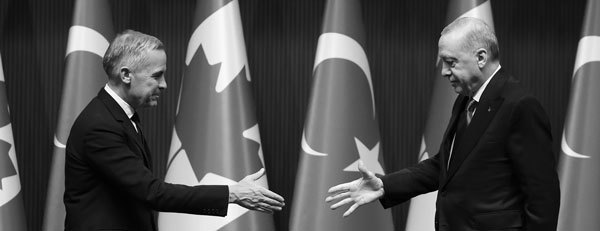
The latest on this came right from the prime minister, during a press conference that took place in Istanbul while this country was asleep.
"We could sign it [a deal] this afternoon if the U.S. were there. If it has to be months from now or longer than that, or another administration before a proper deal comes into place, we would do that," he said.
Pressed on how much the timing matters, Carney said Canada would "drop everything" if the Americans were ready to negotiate in good faith, but the chance of that happening before the midterms is "up to the United States, they're a little hard to predict."
Potentially challenging an imminent deal though, the Americans have also spent a considerable amount of energy this week casting Canada as a country that meddles in its elections.
After the prospect was floated directly by U.S. Ambassador to Canada Pete Hoekstra during a recent podcast appearance, his office issued a detailed "fact sheet" saying the U.S. government is monitoring Canadian activities in American politics.
The sheet points to documents, comments, and appearances by Canadian officials, claiming them as examples of interference.
"There is no merit to these claims, so I'll call it out that way. I'm disappointed that their envoy sees that it's his role to make these suggestions," Carney said during his overnight press conference.
He also confirmed that Canadian officials working in the U.S. have been cautioned to ensure they stay away from current American candidates as to not give the White House any more fodder.
And, while this trade drama and continues to play out, and the midterms near, this week the prime minister hosted Ontario Premier Doug Ford to unveil nearly $9 billion in supports for the province's tariff-hit auto and steel sectors.
As CTV Toronto colleagues Joshua Freeman and Bryann Aguilar report, the commitments under the "new action plan" include $5 billion to help upgrade Ontario steel mills and $2.5 billion to help the province’s ailing auto industry pivot to electric vehicle production.
"As we stand here today, it's clear that Canada's relationship with the United States has changed permanently," Ford said. "No matter what happens in the midterms, no matter who sits in the White House, we're not going back to the way things were, and we need to plan accordingly."
Lastly, as Bill C-39, Carney's Building Canada Strong Act continued its accelerated path through Parliament this week – seeing a panel of ministers face a compacted grilling session – the pushback to the proposal is heating up.
More than 50 of Canada's top scientists and scholars are warning that the legislation aimed at fast-tracking regulatory approvals for major projects needs to be amended, or the federal government is risking "costly and potentially irreversible harm," to the environment.
In an open letter published Thursday, 56 fellows from the Royal Society of Canada outline six specific amendments they say need to be made. They say the changes are needed for the government to keep its promise to protect species at risk, delicate ecosystems, natural resources and human well-being.
"Bill C-39, as drafted, really puts aside a lot of the environmental regulations and laws that we have in place in Canada to protect nature and protect our waters, protect our air," said Dr. Sarah Otto in an interview with CTV News.
Otto, one of the signatories and a zoology professor at the University of British Columbia, said the speed at which the bill is moving was a key motivator for the coalition to come together over the past week and produce the letter. It has since been submitted as a brief to key parliamentarians.
The experts behind the letter have requested to appear as witnesses before the special committee studying Bill C-39, but they haven't been invited, yet. This push for changes, and a so far limited number of critical voices heard by MPs, has cast new light on the makeup of the committee itself.
Of the 12 members tasked with studying the legislation, 11 of them have already voted in favour of it, the standout being the sole Bloc Quebecois MP at the table. Neither Green Party MP Elizabeth May nor any NDP MPs were invited to join the committee, after both sought an exception to participate without official party status.
"The only vehicle open to us as parliamentarians is to amend the bill, but that process is severely limited," said NDP Parliamentary Leader Don Davies in an interview with CTV News.
The Liberals have restricted the amount of time to hear from witnesses they haven't hand-selected, to eight hours, Davies said, adding the "inescapable" conclusion from the decision is that Carney isn't interested in hearing opposition, which he said could open up a huge political risk of project delays due to court challenges or protests.
Per the workplan MPs agreed to, any proposed amendments to Bill C-39 are due to the committee clerk by 5 p.m. ET on Nov. 4, with clause-by-clause consideration taking place mid-month.
CTV News asked Minister of the Environment, Climate Change and Nature Julie Dabrusin's office for comment on both the specific scientific concerns and the reservations about the committee process.
In an emailed response, Dabrusin's office reasserted that Bill C-39 will not compromise on environmental standards, and said the government remains open to receiving public feedback but wouldn't commit to considering any amendments. |














Comments
Post a Comment
Thank you to leave a comment on my site